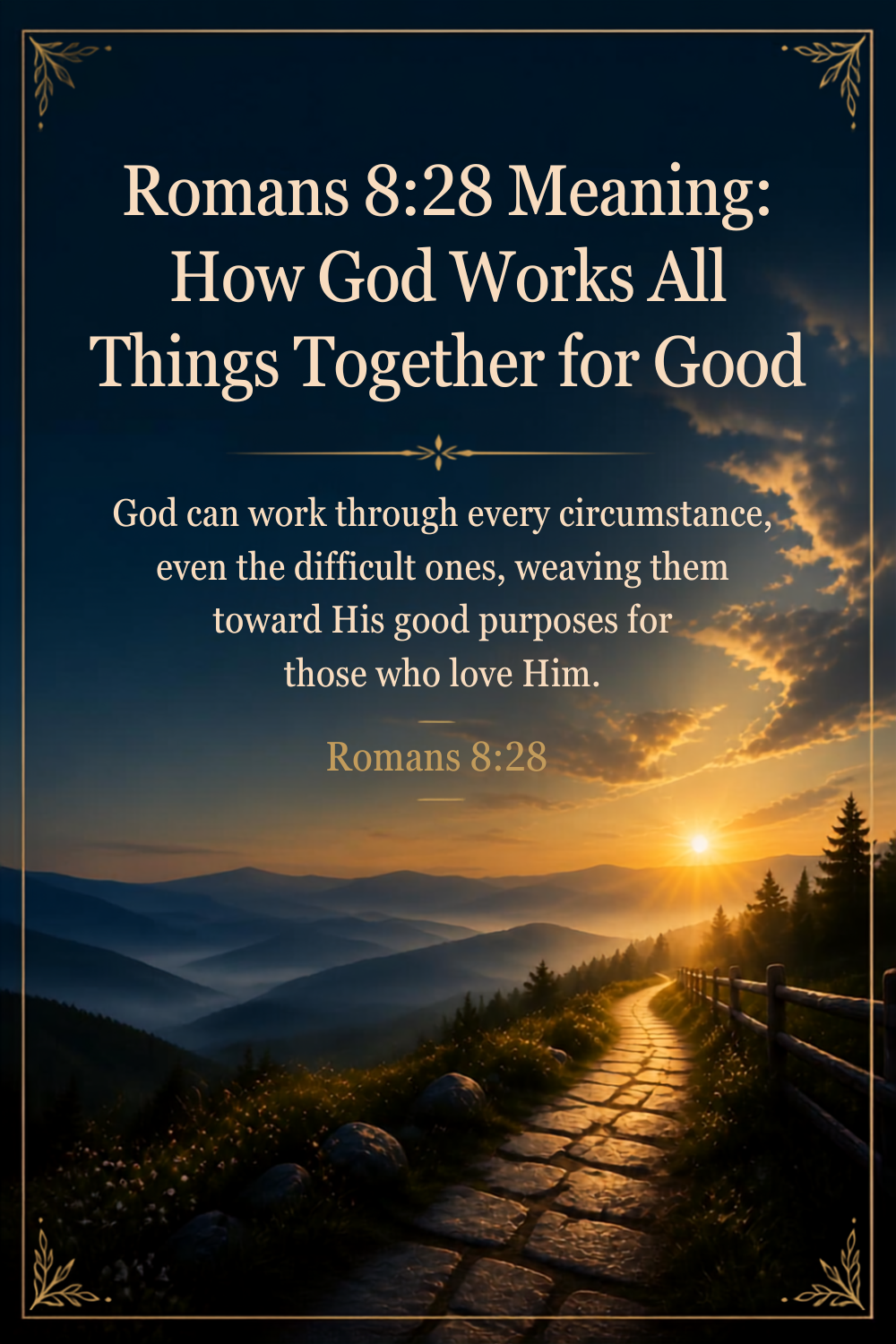
The Romans 8:28 meaning has brought hope to countless believers walking through grief, disappointment, uncertainty, and seasons they did not understand. It is a powerful reminder that our circumstances are never beyond God’s knowledge, presence, or sovereign control.
Affiliate Disclosure: This post contains affiliate links. If you purchase through one of these links, I may earn a commission at no additional cost to you.
Romans 8:28 declares:
“And we know that all things work together for good to them that love God, to them who are the called according to his purpose.” — Romans 8:28 KJV
This verse does not say that everything that happens to us is good. Loss is painful. Betrayal is wrong. Sickness brings suffering. Rejection hurts, and unanswered questions can leave us feeling confused and discouraged.
The promise is that God can take everything we experience—the joyful moments, painful chapters, delays, mistakes, disappointments, and unexpected changes—and work through them for a greater purpose.
We may not see what He is doing immediately. We may not understand why He allowed a certain situation to enter our lives. Nevertheless, Romans 8:28 assures believers that God is working even when His hand is difficult to see.
A Daily Reminder That God Is Working
Keeping Scripture visible in our homes can help redirect our thoughts toward God when circumstances attempt to overwhelm us. The Romans 8:28 wall art featured in this article displays a quiet but powerful declaration:
“All things work together for good.”
Its peaceful design and budding tree branch can serve as a beautiful reminder that God can produce new growth even after a difficult season.
This Christian Scripture wall art could create a meaningful focal point in a living room, bedroom, prayer space, hallway, or office.
View this Romans 8:28 Christian wall art on Etsy.
What Is the Meaning of Romans 8:28?
The Romans 8:28 meaning is that God sovereignly works through every circumstance to accomplish His good purposes in the lives of those who belong to Him.
This is not a promise that believers will avoid suffering. It is a promise that suffering, hardship, and disappointment will never have the final word.
God sees the entire story, while we usually see only the chapter we are currently living. We see the unanswered prayer, but God sees where He is leading us. We see the closed door, but God knows what was behind it and what He may be preparing ahead of us.
We see the delay, but God sees the necessary preparation taking place within us.
Because God possesses perfect wisdom, He can work through circumstances that appear disconnected, confusing, or even devastating. Nothing surprises Him. Nothing forces Him to abandon His plan.
Our lives are not a collection of random events held together by chance. God remains present and active, faithfully directing His children toward His eternal purpose.
Romans 8:28 Does Not Say That Everything Is Good
One of the most important truths about the Romans 8:28 meaning is the distinction between everything being good and everything working together for good.
The Bible never asks us to call evil good.
Abuse is not good. Death is not good. Betrayal is not good. Disease, injustice, and cruelty entered the world through sin and human rebellion. Jesus Himself wept at the tomb of Lazarus, even though He knew that Lazarus would soon be raised from the dead.
God does not dismiss our pain or demand that we pretend it does not hurt.
Instead, He enters our suffering and promises that evil will not ultimately defeat His purposes. God is so powerful that He can take circumstances the enemy intended for destruction and use them to accomplish something redemptive.
Joseph expressed this truth after enduring betrayal, slavery, false accusation, and imprisonment. Speaking to the brothers who had sold him, Joseph said:
“But as for you, ye thought evil against me; but God meant it unto good.” — Genesis 50:20 KJV
Joseph did not say that his brothers’ actions were good. He recognized that their intentions were evil. Nevertheless, God worked through those events to place Joseph in a position where he could preserve many lives during a famine.
The evil remained evil, but it could not overpower God’s plan.
What Does “All Things” Include?
Romans 8:28 says that all things work together for good. This includes far more than the pleasant moments of life.
“All things” can include:
- Unexpected changes
- Closed doors
- Financial hardship
- Physical illness
- Grief and loss
- Seasons of waiting
- Disappointment
- Rejection
- Family difficulties
- Career setbacks
- Personal weaknesses
- Painful consequences
- Spiritual battles
- Prayers that appear unanswered
- Mistakes we sincerely bring before God
This does not mean every circumstance will end exactly as we desire. Sometimes God changes our situation, while at other times He uses the situation to change us.
He may use hardship to deepen our faith, expose misplaced priorities, build spiritual endurance, redirect our path, or teach us to depend upon Him more completely.
What feels like an interruption may become part of His preparation. What looks like a delay may be His protection. What feels like an ending may become the place where God begins something new.
“All Things Work Together”
The words “work together” are essential to understanding the Romans 8:28 meaning.
Individual events may not appear beneficial when viewed by themselves. Their purpose may become clearer only when we see how God connects them to other parts of our story.
A single ingredient in a recipe may taste bitter or unpleasant alone. When it is combined with other ingredients in the proper amount and placed in the hands of someone who understands the complete recipe, it contributes to the finished result.
In a far greater way, God understands how every part of our lives fits into His complete plan.
We may focus on one painful event and wonder how anything good could emerge from it. God sees that moment in relationship to everything He has already done, everything He is presently doing, and everything He will accomplish in the future.
We should never minimize suffering with shallow statements or tell hurting people that they should immediately feel happy about their pain. Romans 8:28 offers something deeper than a quick explanation. It gives us confidence in God’s character when explanations are unavailable.
What Does “For Good” Mean?
When we read that God works all things “for good,” we may naturally define good as comfort, prosperity, success, physical healing, or the removal of every difficulty.
Those blessings may be part of God’s provision, but Romans 8 gives us a deeper definition.
The following verse explains God’s purpose:
“For whom he did foreknow, he also did predestinate to be conformed to the image of his Son.” — Romans 8:29 KJV
The ultimate good is becoming more like Jesus Christ.
God’s primary purpose is not simply to make our earthly lives comfortable. He is preparing His children for eternity and shaping their character to reflect His Son.
Therefore, the “good” God produces may include:
- Stronger faith
- Greater patience
- Deeper compassion
- Freedom from pride
- Increased dependence upon God
- Spiritual maturity
- A clearer understanding of Scripture
- Courage to obey God
- A more Christlike character
- Opportunities to comfort others
- A testimony that points people to Jesus
- Eternal rewards that cannot be taken away
A situation may not feel good while God is using it for our good. Spiritual growth often occurs in places we would not have chosen for ourselves.
The Promise Is for Those Who Love God
Romans 8:28 contains a specific promise for “them that love God” and “them who are the called according to his purpose.”
This verse is not a general promise that every decision will automatically produce a favorable result for everyone, regardless of how that person lives. It is directed toward people who belong to God through faith and are being drawn into His purposes.
Loving God does not mean living a perfect life. Believers still struggle, make mistakes, and need God’s grace. Loving God means that our hearts have been turned toward Him. We trust Christ, desire to obey His Word, and seek His will even when our faith is tested.
Our confidence is not based upon our ability to control every circumstance. It rests upon the faithfulness of the God who called us.
God’s love for us is even greater than our love for Him. Earlier in Romans 8, Paul explains that there is no condemnation for those who are in Christ Jesus. Later in the chapter, he declares that nothing can separate believers from the love of God.
Romans 8:28 stands within this larger message of security, hope, and victory in Christ.
Romans 8:28 in the Context of Suffering
To understand the complete Romans 8:28 meaning, we must read it within the context of Romans 8.
Paul was not writing to people who had never experienced suffering. The chapter discusses weakness, groaning, waiting, persecution, distress, and uncertainty.
Romans 8:18 says:
“For I reckon that the sufferings of this present time are not worthy to be compared with the glory which shall be revealed in us.” — Romans 8:18 KJV
Paul did not deny present suffering. He placed it beside the future glory God has promised.
Romans 8 also explains that creation groans because of the effects of sin. Believers groan while waiting for the complete redemption of their bodies. Even when we do not know how to pray, the Holy Spirit intercedes for us.
Then comes Romans 8:28.
The verse is not disconnected from pain. It was written for people living in the middle of it.
God’s promise does not mean we will never cry. It means our tears are not wasted. It does not mean we will never experience loss. It means loss cannot separate us from God’s love or cancel His eternal purpose.
God Is Working When We Cannot See Him
There are seasons when God’s work is obvious. A prayer is answered, an opportunity appears, a relationship is restored, or a need is unexpectedly supplied.
Other seasons feel silent.
During those times, we may wonder whether God has forgotten us. We pray but do not see an answer. We remain faithful but watch doors continue to close. We ask for direction but still feel uncertain about the next step.
The Romans 8:28 meaning reminds us that God does not have to be visible to be active.
Seeds grow beneath the soil before any evidence appears above the ground. In the same way, God may be working in hearts, circumstances, relationships, and future opportunities before we see the results.
Faith means trusting His character during the hidden stages of His work.
“For we walk by faith, not by sight.” — 2 Corinthians 5:7 KJV
Our sight is limited to what is presently happening. Faith looks beyond the visible situation and rests in what God has revealed about Himself.
He is wise.
He is faithful.
He is loving.
He is sovereign.
He does not abandon the work of His hands.
When God’s Plan Looks Different From Ours
Sometimes we quote Romans 8:28 while secretly expecting God to make our original plans succeed. We may assume that “working for good” means He will restore precisely what was lost or give us exactly what we requested.
God may do those things, but His wisdom is greater than our preferred outcome.
Proverbs teaches:
“A man’s heart deviseth his way: but the Lord directeth his steps.” — Proverbs 16:9 KJV
We make plans based upon the information available to us. God directs us with complete knowledge of the future.
A closed door may prevent us from entering a harmful situation. A delay may allow necessary preparation. An ending may create space for a new assignment. A disappointment may expose something we had placed above God.
We may eventually understand why God redirected us, but some answers may not become clear during this lifetime. Faith does not require us to understand everything. It requires us to trust the One who does.
Display the Promise of Romans 8:28
Scripture wall art can turn an ordinary room into a place filled with reminders of God’s truth. The featured design displays Romans 8:28 with a graceful branch and soft, neutral colors that can complement many decorating styles.
More importantly, its message can encourage you to pause and remember that God is still working.
Place it somewhere you will see it during your daily routine—perhaps above a desk, beside a prayer chair, in a bedroom, or in an entryway. When worries arise, allow the words to redirect your thoughts from what you cannot control to the God who remains in control.
See the details and current availability of this Romans 8:28 wall art on Etsy.
Affiliate link: I may earn a commission if you make a qualifying purchase at no additional cost to you.
How God Can Use Difficult Seasons
The Bible contains many examples of God working through circumstances that initially appeared hopeless.
Joseph’s Betrayal
Joseph was betrayed by his brothers and sold into slavery. He later experienced false accusations and imprisonment. Nevertheless, God used each stage to position him for an assignment that would save many people.
Ruth’s Loss
Ruth experienced the death of her husband and entered an uncertain future. Her decision to remain with Naomi eventually led her to Bethlehem, where God provided a redeemer through Boaz. Ruth became part of the family line through which Jesus Christ entered the world.
David’s Wilderness
David was anointed to become king, yet he spent years fleeing from Saul. Those wilderness years developed his dependence upon God and prepared him to lead the nation.
Esther’s Position
Esther entered the palace without fully understanding why God had placed her there. When her people faced destruction, it became clear that her position carried a greater purpose.
The Crucifixion of Jesus
The greatest example is the cross.
To the disciples, the crucifixion looked like the end of every hope. Jesus had been rejected and killed. His body was placed in a tomb.
Yet through the cross, Jesus paid for humanity’s sins. Through the resurrection, He conquered death. What appeared to be the darkest moment in history became the means through which salvation was offered to the world.
God brought redemption out of what appeared to be complete defeat.
How to Trust Romans 8:28 During Hard Times
Knowing the verse is important, but applying it during hardship requires intentional faith.
1. Be Honest With God
You do not have to hide your grief, fear, disappointment, or confusion. The Psalms contain honest prayers from people who loved God but struggled deeply.
Tell God where you are hurting. Faith is not pretending everything is fine. Faith brings the truth of our pain into the presence of the One who can sustain us.
2. Remember God’s Character
Circumstances change, but God’s character remains constant. When you cannot understand His plan, remember what Scripture reveals about Him.
God is good even when life is painful. He is present even when you feel alone. He is faithful even when the future is uncertain.
3. Continue Obeying What You Know
We may not understand the entire plan, but we can obey the next instruction God has already made clear through His Word.
Continue praying. Continue forgiving. Continue showing kindness. Continue resisting temptation. Continue doing what is right.
Small acts of obedience keep our hearts aligned with God while we wait for direction.
4. Refuse to Let Fear Write the Ending
Fear looks at the present difficulty and predicts permanent disaster. Faith acknowledges the difficulty but leaves the final outcome in God’s hands.
The current chapter is not the entire story.
5. Look for Spiritual Growth
Instead of asking only, “When will this end?” consider asking, “Lord, what are You teaching me?”
God may be developing patience, courage, discernment, compassion, or a stronger prayer life through the season.
6. Give God Time
Some of God’s work becomes visible only after years have passed. Do not judge His entire plan by one unfinished moment.
“Trust in the Lord with all thine heart; and lean not unto thine own understanding.” — Proverbs 3:5 KJV
Romans 8:28 Does Not Excuse Careless Choices
Trusting that God works all things together for good does not mean we should behave recklessly and expect Him to remove every consequence.
God’s grace can redeem our mistakes, but grace is not permission to ignore wisdom, Scripture, or responsibility.
We should seek God before making decisions, listen to sound biblical counsel, and correct harmful behavior when He brings it to our attention.
If our actions have hurt someone, faith may require confession, apology, restitution, or changed behavior. God can work through our failures, but genuine repentance accepts responsibility.
Romans 8:28 encourages trust in God’s redemptive power. It does not encourage irresponsible living.
How Romans 8:28 Can Change Our Perspective
The Romans 8:28 meaning does not always change our circumstances immediately, but it can transform how we view them.
Instead of seeing only a delay, we begin to consider that God may be preparing us.
Instead of viewing rejection as proof that we have no value, we remember that our identity rests in Christ.
Instead of allowing mistakes to define us permanently, we bring them to God and trust His ability to redeem what we surrender.
Instead of believing suffering is meaningless, we recognize that God can use our experiences to prepare us to help others.
Paul wrote:
“Who comforteth us in all our tribulation, that we may be able to comfort them which are in any trouble.” — 2 Corinthians 1:4 KJV
Sometimes the comfort we receive during our pain becomes the comfort we later offer to someone else. Our testimony may become evidence that God remains faithful in places where another person is struggling to believe.
A Prayer for Trusting God’s Plan
Father, thank You that nothing in my life is hidden from You. You see the circumstances I understand and the ones that leave me confused.
Help me trust that You are working even when I cannot see the outcome. Guard my heart against fear, bitterness, and discouragement. Give me wisdom to recognize what You are teaching me and courage to obey You one day at a time.
Use every part of my story for Your glory and my eternal good. Transform me into the likeness of Jesus. Help me remember that my present circumstances are not more powerful than Your promises.
I place my plans, unanswered questions, disappointments, and future into Your hands. Thank You for loving me and for remaining faithful through every season.
In Jesus’ name, amen.
Keep the Promise of Romans 8:28 Before You
The Romans 8:28 meaning gives believers more than temporary encouragement. It provides a firm foundation for trusting God when life does not make sense.
Not everything we experience is good, but God is good.
We may not understand everything He permits, but we can trust His wisdom. We may not see how the pieces fit together, but He sees the completed picture.
This unique Romans 8:28 wall art offers a beautiful way to keep that promise visible in your home. It may also make a meaningful Christian gift for someone experiencing change, grief, uncertainty, or a season of waiting.
View this “All Things Work Together for Good” wall art on Etsy today.
This is an affiliate link. I may earn a commission from qualifying purchases at no additional cost to you.
The next time life takes an unexpected turn, remember Romans 8:28. God has not lost control. He has not forgotten you, and He has not abandoned His purpose.
Even when you cannot see it, God is still working.